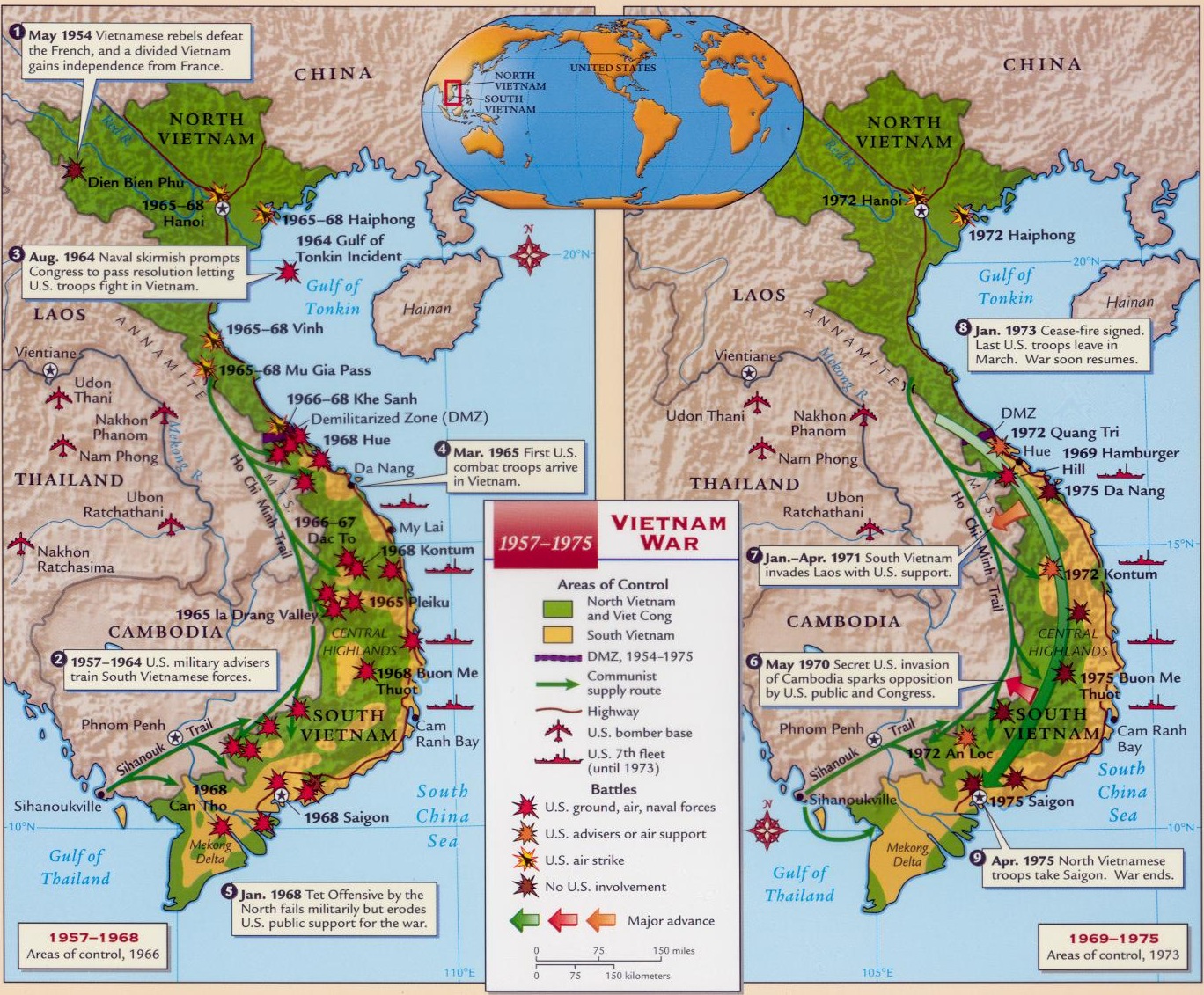
Maps of the Vietnam war.
Part Three. The United States and the Vietnam war.
January 16, 2026
➙ Ordre de passage pour les oraux blancs du 2e trimestre en salles 138 / 138bis. Voir le programme sur l'ordre de passage.
1 | The origins of the war and the Domino Theory.
➣ What is that makes the Vietnam war a defining moment in American history ?
- It was a “first” : the 1st war ever lost by the USA.
- And it was a national trauma, an ordeal that divided the nation very deeply.
- The “domino theory”, invented in the 1950s, said that if one single Southeast Asian state fell to communism, all other states would follow.
- After the French war in Indochina (1946-1954), two Vietnamese states were created : the communist North Vietnam (NVN) and the non-communist South Vietnam (SVN). As a consequence, NVN would try to reunify the country.
- So, the US made a strategic mistake : they were willing to contain communism in Asia, just as they did successfully in Europe. In Vietnam, however, they were fighting a nationalism, not only communism.
➪ Subject № 1: The Vietnam Quagmire. Senator J. William Fulbright criticized the involvement in Vietnam as early as 1966 in an essay on “the arrogance of power”.
January 30, 2026
2 | Escalation.
➪ Subject № 2 : Why did the US lose the Vietnam war ?
➪ Subject № 3 : The Vietnam war, a national trauma.
➙ Do not forget this ! Oraux blancs du 2e trimestre en salles 138 / 138bis. Voir le programme sur l'ordre de passage.
❑ In 1961-63, JFK had sent military advisors to SVN, to prevent the Vietcong (VC) from overwhelming the country.
❑ Kennedy did not want to escalate. He knew it was risky. But in November 1963, he was assassinated.
❑ Lyndon B. Johnson (LBJ), who succeeded him, did not have the same experience in military and foreign affairs. In 1964, he took advantage of an incident (“the Tonkin Gulf incident”), to pass a resolution (the “Tonkin Gulf resolution”), that gave him full authority to escalate the war.
⇒ In 1965, 500,000 American soldiers were in SVN. Meanwhile, the US Air Force was bombing NVN (“operation Rolling Thunder”, in which the B-52s of the Strategic Air Command were involved).
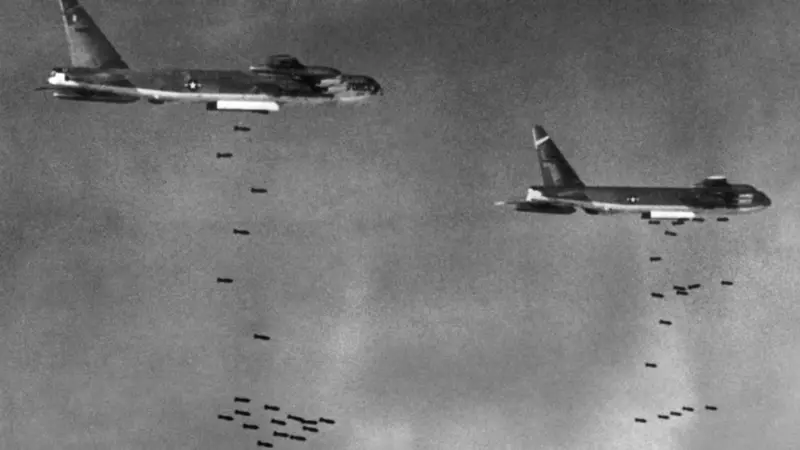 USAF B-52s bombing North Vietnam during the war.
❑ That huge US expeditionary corps required a draft. And the draft soon created dissent in the US. Most of the draftees were high school boys or students. So, there were demonstrations and draft-dodgers. Besides, the war was dirty. The bombings (sometimes with napalm) killed a lot of people. And the war was asymmetrical : the inexperienced, “green” draftees had to face guerilla tactics in a hostile environment. More, the war was shown on TV. For the very first time, the public was witnessing the horrors of the war. And for most of the viewers, it was unbearable.
February 6 and 13, 2026
➪ Subject № 4 : The memories of the Vietnam war. John McCain and Donald Trump.
3 | Dissent
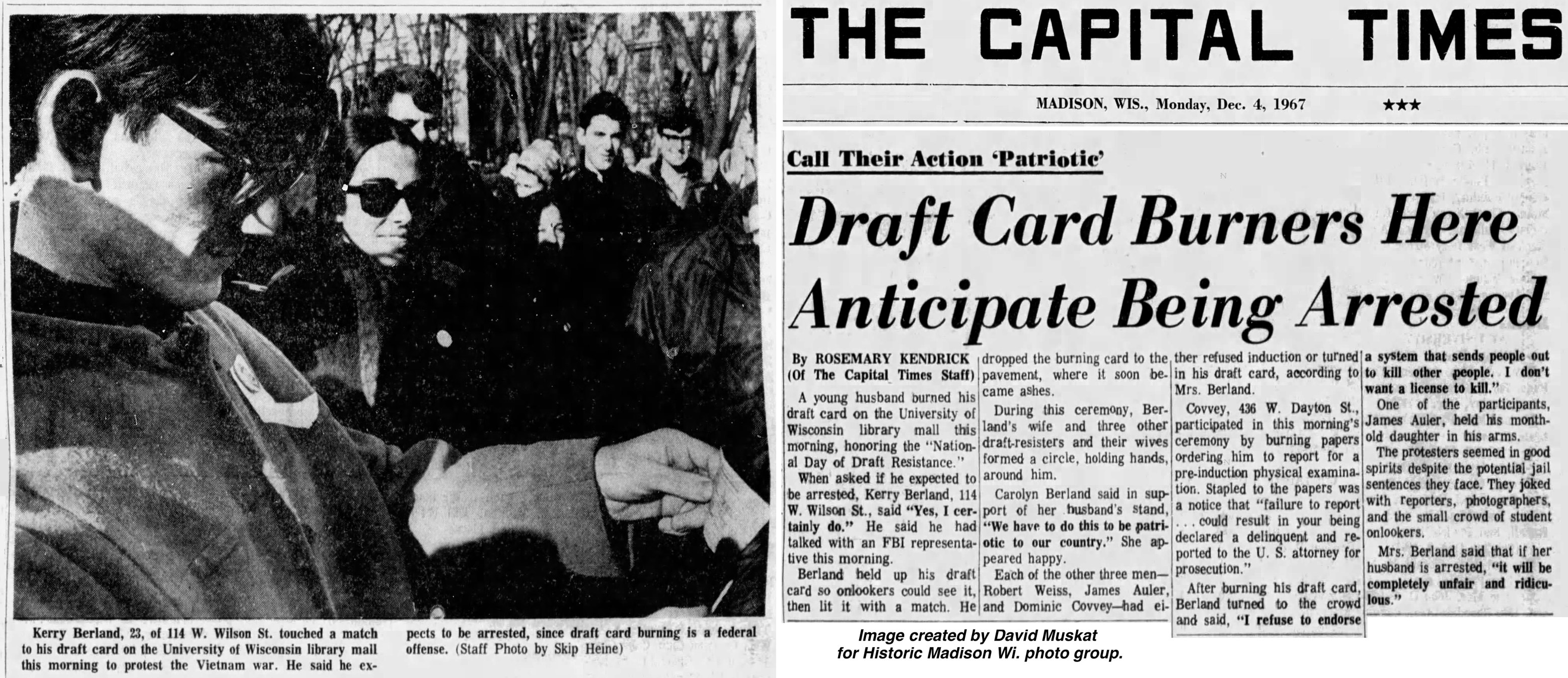
Students burning draft card at the University of Wisconsin in Madison in December 1967. Campuses became hotbeds of dissent, because the students wanted to escape the draft and opposed the means used by the US government to wage that war. In Madison, the protest started in October 1967 as Dow Chemical, a company that produced plastic wraps and napalm, came to the campus to hire students.
➪ Subject № 5 : The Vietnam war in literature. An excerpt from Philip Roth's novel The Human stain. This subject does not conform with the regulations of your final test. It is provided as a document.
An analysis of that text can be found here.
March 6 and 13, 2026
➙ Subject № 3 : The Vietnam war, a national trauma (annotated).
4 | Vietnamization
- Escalation proved to be a strategic mistake.
- Instead, dissent started to spread all over the US.
- To the point that, in 1968, LBJ did not seek a second term.
- Nixon, the Republican candidate (defeated by Kennedy in 1960), won the election. His aim was to put an end to the Vietnam war, and to withdraw the troops. He was seeking “peace with honor”. The idea was to pull out, and to leave the mess to the Vietnamese.
- Nixon decided to withdraw the troops stepwide, while negotiating with Hanoï. Meanwhile, Nixon increased the bombing of North Vietnam. He bombed Cambodia to hit the Ho Chi Minh trail in 1970.
In 1972, he hit North Vietnam harder than ever (the “Christmas bombings”).
- Simultaneously, he sent his adviser, Henry Kissinger, to China, and in 1972 went on the 1st state visit of a US president in China. The new relationship with China upset the USSR and its North Vietnamese ally. It was intended to make up for the expected loss of South Vietnam.
- Nixon’s trip had far-reaching consequences, because it was the beginning of the US-Chinese relationship that later shaped globalisation.
- The new balance of power enabled the success of the negotiations led by Kissinger and his North Vietnamese counterpart Le Duc Tho in Paris. Kissinger only asked for “a decent interval” between the withdrawal of the last US troops and the annexation of South Vietnam by the North.
- In 1973, the peace was signed and the US left Vietnam. Two years later, the South was reunified with the North.
March 20, 2026
The Vietnam war in Literature
➪ Subject № 5 : The Vietnam war in literature. An excerpt from Philip Roth's novel The Human stain. This subject does not conform with the regulations of your final test. It is provided as a document.
An analysis of that text can be found here.
March 27, 2026
The Vietnam war in movies
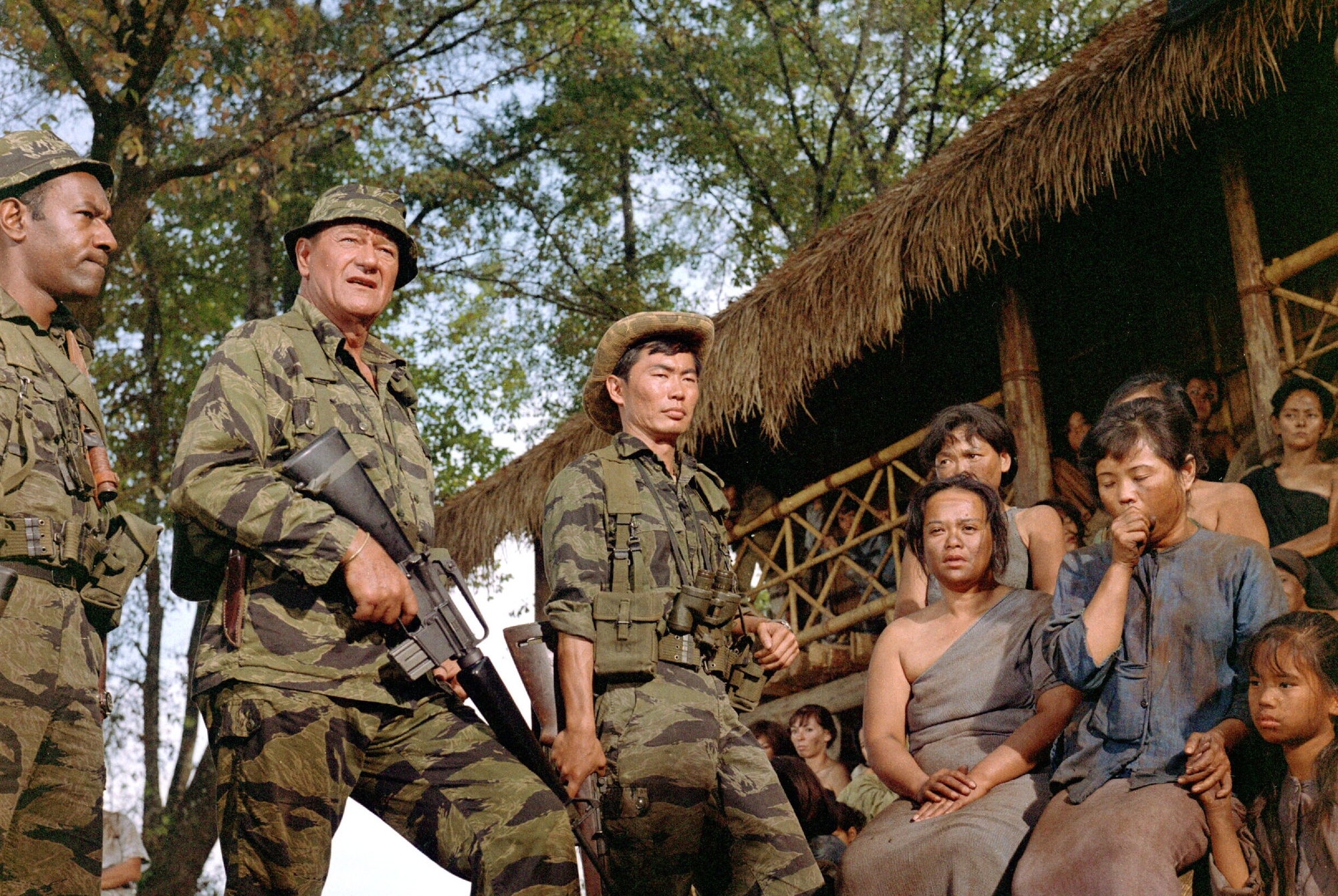
John Wayne as colonel Mike Kirby in The Green Berets. The film translates the narrative of westerns in the Vietnamese context. The heroes are battle-hardened, professional soldiers – not draftees –, who fight a just war to protect the Vietnamese, far away from the bleak reality of the Vietnam war.
❑ Only a few directors decided to support the war. E. g : John Wayne, in The Green berets (1968). The movie praises the heroes of the US special forces. It’s jingoistic and boring. An act of denial. Read the devastating criticism from The Guardian. Watch the trailer on YouTube.
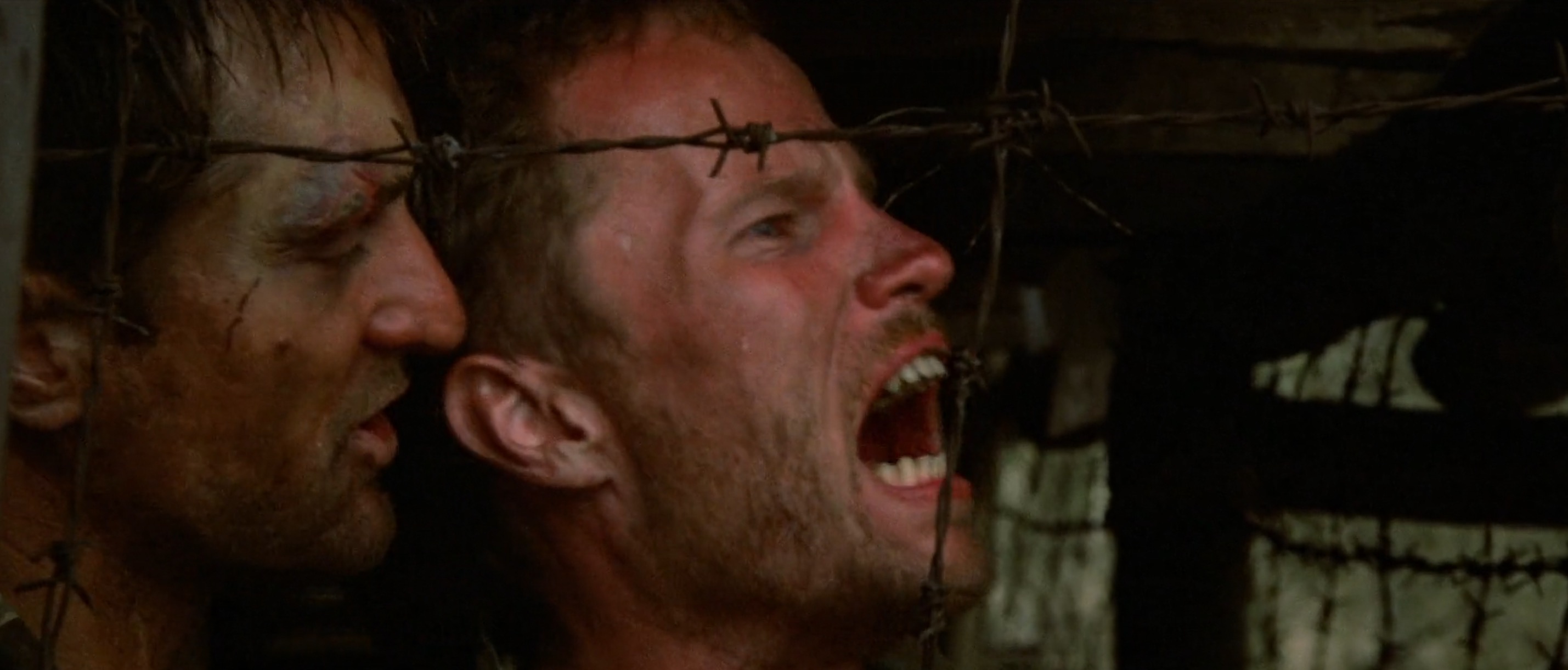
In The Deer Hunter, Michael Cimino describes the traumatic experience of American POWs in Vietnam..
❑ Most movies were against the war. In 1978, a few years after the end of the war, Michael Cimino made The deer hunter, which insists on the trauma of the war. US soldiers are tortured. Forced to play the Russian roulette (they have got to shoot themselves with a revolver that contains only one bullet), they are driven mad. Watch the trailer on YouTube.
Rambo (Stallone) : A Reaganite on screen ?
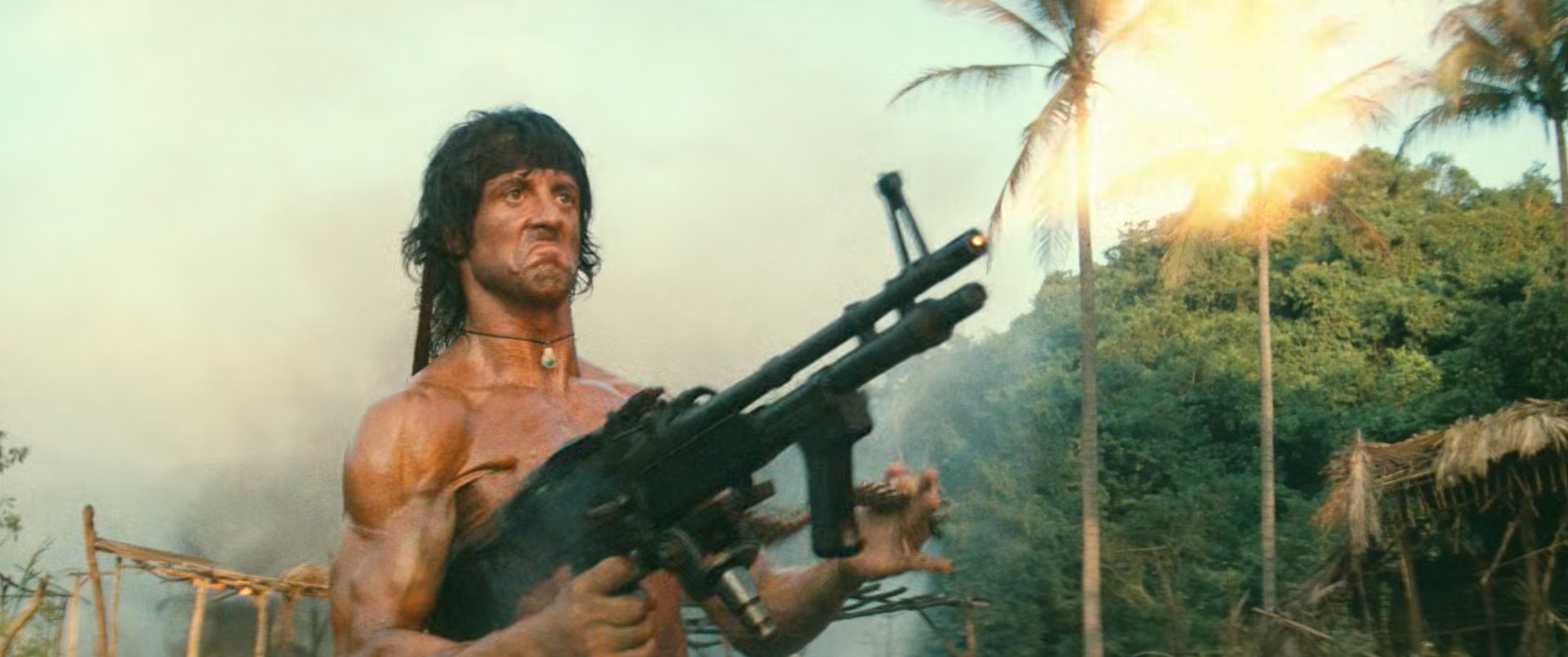
In 1985, Rambo II, with Sylvester Stallone, epitomised the mindset of the Reagan era : “America is back”. A Vietnam veteran, more muscles than brains, rescues American POWs in Vietnam, as if it were possible to wage the war once again, and to win it.
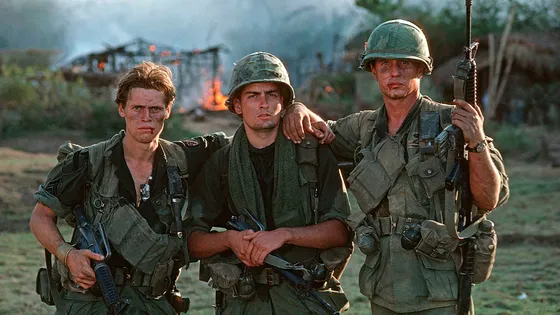 Actors Willem Dafoe, Charlie Sheen and Tom Berenger on the shooting of Oliver's Stone
 Platoon
in the Philippines, January 1986..© Getty.
❑ In 1986, Oliver Stone shot Platoon. A story more or less influenced by the My Lai massacre. After committing war crimes, US soldiers are attacked by the Viet Cong, just when they are being rescued. Watch the trailer on YouTube. An epic moment is the death of sergeant Elias (Willem Dafoe), set against the musical backdrop of a string adagio, arguably the best piece of the film. [3'18"]
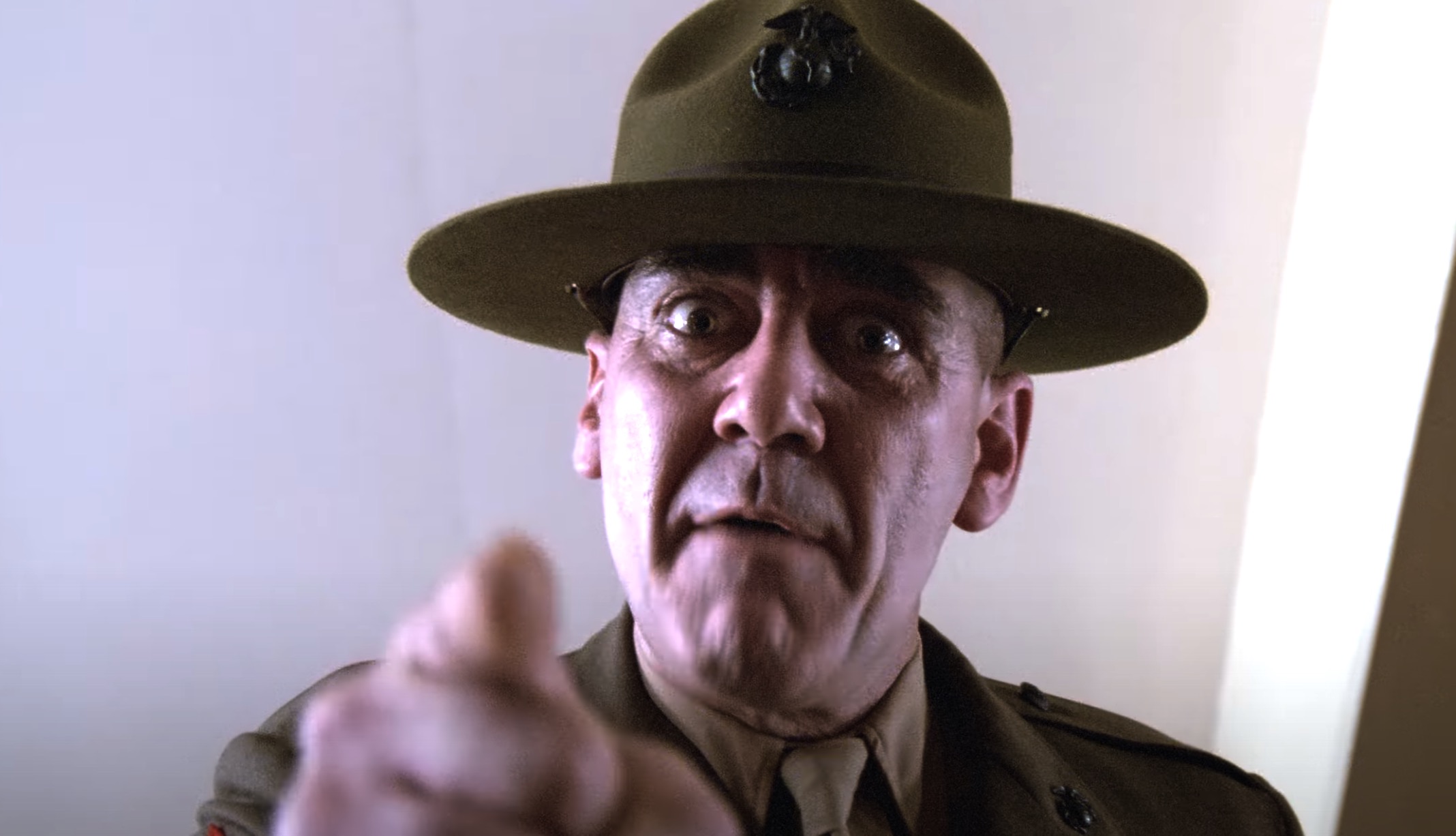 Gunnery sergeant Hartman (R. Lee Ermey)
.
❑ In 1987, Full metal jacket was Stanley Kubrick’s Vietnam war movie. It starts with scenes of drill for recently drafted US Marines. The military institution is mocked through the character of the sergeant. The same satirical mood appears in the scenes in Vietnam, in which the uselessness and cruelty of the war is emphasized. There is nothing heroic in it. Watch the trailer on YouTube.