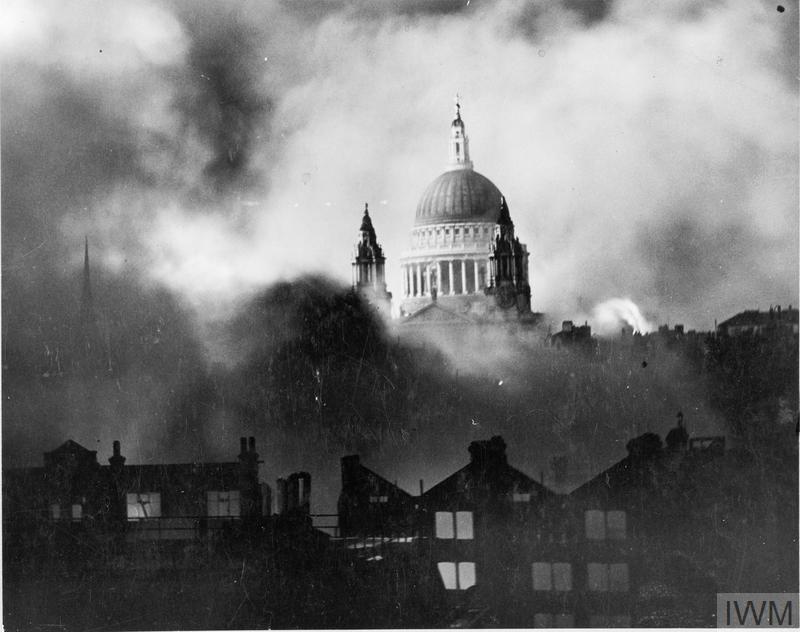
“St Paul's Survives” Herbert Mason's photograph of Saint Paul's cathedral shrouded in smoke during the Blitz in the night of 29-30 December 1940. The cathedral became a symbol of British resilience almost instantly. Picture: IWM.
Part One: Britain in WW2
➪ Online book: The account of RAF Anglo-Australian pilot Richard Hillary, The Last Enemy, published in 1942. Hillary fought the Battle of Britain and became a fighter ace. In September 1940 he was shot down over the Channel and badly burnt. After a long recovery, during which he witnessed the Blitz, he asked to be sent back to flying status and died when his plane crashed on take off.
October the 2rd, 2026
3 | The Blitz and the home front
➪ Watch: London can take it!, a movie produced by the British Minister of Information in 1940. This film was mostly intended for American audiences with the purpose of bringing the United States into the war (short movie watched in class on October 3).
➪ Read: The English historian David Reynolds makes that account of the part played by London can take it! in his book From Munich to Pearl Harbor: Roosevelt's America and the origins of the Second World War (2001):
For Americans the Blitz was supremely a radio war. The major U.S. networks sent some of their best correspondents to London. The most celebrated was Edward R. Murrow of CBS, whose live broadcasts of air raids brought the sounds of modern war into American living rooms. Murrow’s matter-of-fact, gravelly voice told its story against the wail of air-raid sirens, the crump-crump of exploding bombs, and the clatter of antiaircraft guns. "You burned the city of London in our homes, and we felt the flames,” wrote the poet Archibald MacLeish in tribute. The British Ministry of Information (MOI) gave Murrow and colleagues such as Eric Sevareid full cooperation, waiving their normally strict censorship requirements because of the evident effect in the United States. The MOI’s documentary film about the Blitz, entitled London Can Take It, was also aimed at U.S. audiences. The MOI deliberately recruited an American commentator, the journalist Quentin Reynolds, who began his account of a night raid on the capital with the words: "These are not Hollywood sound effects. This is the music they play every night in London.” The MOI kept its name off the credits and used Warner Brothers to distribute the film around the United States. Opening in early November 1940, by the next spring London Can Take It had been screened at twelve thousand cinemas to an estimated sixty million Americans.
➪ Watch: In which we serve a 1942 British war film, the story of a Royal navy destroyer sunk in the Mediterranean, while the families of the sailors are being bombed in London. The film, which praises the heroism of the seamen and the resilience of the civilians, was intended to uphold the morale of the population within the framework of war propaganda. Directed by Noël Coward and David Lean, this patriotic film didn't lack artistic qualities.
9 october 2026
❑ WW2, for Britain, was the people’s war. The government led by Churchill was a national government, which included all political parties represented in the House of Commons.
❑ The working class was willing to fight for victory against Nazi tyranny. They were antifascist. The workers accepted to work longer hours for the same wages. Some of them would work up to 70 hours a week. At the same time, they had to face new hardships : food rationing was established. The whole population had to face the bombings, also known as “The Blitz”. Day after day, German bombers were coming at night and took their toll of British lives. The inhabitants of London and other big cities would spend their nights in shelters. Children had been evacuated to the countryside.
❑ So, the war was all about the resilience of the British people. The war effort led to the emancipation of women. Example given : Maria Blewitt was a WAAF.
❑ There were new expectations : the people wanted to change living conditions after the war. They expected more equality. This led in November 1942 to the Beveridge report, which was a blueprint for a future social security system or Welfare state. Hitler himself was impressed by the Beveridge report.
❑ In 1945, Churchill was confident that he would be reelected. He was acclaimed on VE-day on May 8, 1945. A few days later, he was outvoted. The Labour party won a landslide victory and Clement Attlee, its leader, becape the new PM. His first move was to implement the Welfare state. Another difference was the the Labour party, unlike Churchill, supported decolonisation.
❑ The British suffered harsh living conditions until long after the war. Food rationing , in France, was abolished in 1949, two years after the beginning of the Marshall Plan. In Britain, it was not fully removed until 1955.
➪ Read at the Imperial War Museum: Could the Blitz have worked ?, and Ten incredible stories of bravery during the Blitz.